
Hunting Dog Obedience: Training, Commands & Field Drills

Reliable hunting dog obedience is the difference between a controlled, productive hunt and one filled with missed opportunities. A dog that ignores commands, breaks before the shot, or chases game without permission can disrupt the hunt, reduce retrieval success, and create unnecessary safety risks. Before introducing advanced hunting skills, every gun dog must first develop a solid foundation in obedience that remains dependable under the excitement and distractions of the field.
Compared to basic pet training, hunting dog training prepares dogs to perform in demanding environments where birds flush unexpectedly, gunfire, scent trails, other dogs, and changing terrain constantly test their focus. True field obedience means far more than teaching a dog to sit or stay—it includes reliable recall, steady heel work, controlled retrieves, whistle commands, hand signals, and the discipline to wait for release before pursuing game.
Whether you hunt waterfowl, upland birds, or small game, the principles of hunting dog obedience remain the same. Building consistency requires a structured training plan, gradual exposure to real hunting scenarios, and regular practice that reinforces the behaviors expected in the field.
From young retrievers and versatile bird dogs to experienced gun dogs needing refinement, every hunting companion benefits from a systematic approach to obedience. In this guide, you’ll learn how to develop dependable hunting dog obedience through proven training techniques, essential hunting dog commands, practical field drills, and common mistakes to avoid.
Why Obedience Is the Foundation of Every Hunting Dog
Every advanced hunting skill begins with obedience. Before a dog can perform reliable retrieves, follow hand signals, remain steady on birds, or respond to whistle commands, it must consistently obey basic commands under distraction.
Think of obedience as the operating system for a hunting dog. Without it, natural instincts often lead to rushed retrieves, broken stays, poor recall, and inconsistent field performance. With it, those same instincts become controlled behaviors that the handler can direct with confidence.
For this reason, professional trainers develop obedience before introducing advanced field work. A dog that responds reliably to sit, stay, heel, down, and recall learns new hunting tasks more quickly and performs them with greater consistency. Instead of repeatedly correcting unwanted behavior in the field, the handler can focus on refining hunting skills and building experience.
Whether you’re training a retriever, pointing dog, flushing dog, or versatile gun dog, a solid obedience foundation makes every stage of hunting dog training more productive and reliable.
Key Hunting Dog Commands and Their Purpose
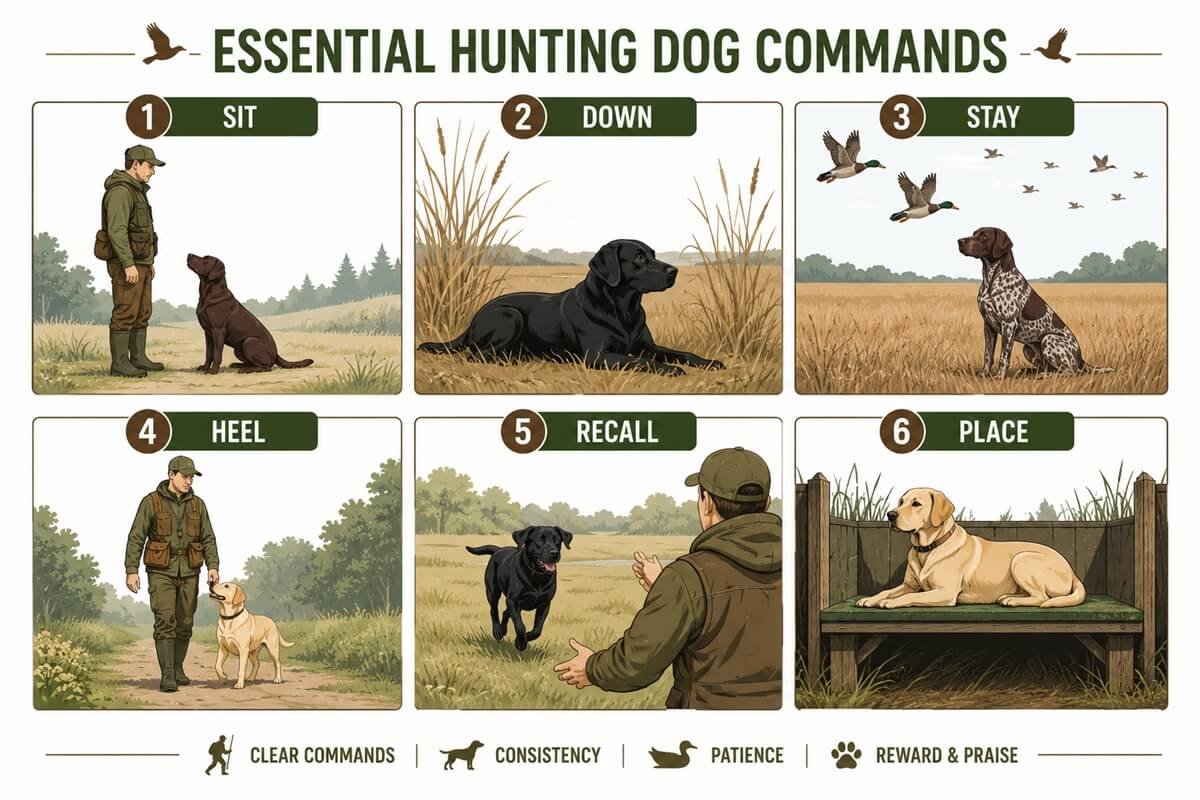
Every command has a specific purpose during a hunt. Some maintain control before the shot, while others guide movement, improve communication, or ensure the dog waits for release. Mastering these essential hunting dog commands before introducing advanced field training creates consistent responses under real hunting conditions.
| Hunting Dog Command | Primary Purpose |
| Sit | Keeps the dog calm and ready for the next instruction. |
| Down | Keeps the dog concealed and stationary in cover or a hunting blind. |
| Stay | Prevents the dog from moving until released. |
| Heel | Maintains control while walking to and from the hunting area. |
| Recall (Come) | Brings the dog back immediately, even under distractions. |
| Place | Teaches the dog to remain on a designated platform or blind until given a new command. |
How to Teach the Sit Command
The sit command is one of the first obedience skills a hunting dog should master because it teaches patience and control. A reliable sit gives the handler a way to pause the dog before movement, during training drills, or before introducing more advanced commands such as stay, place, and whistle cues.
Begin with your dog standing calmly beside you on a leash. Use a clear command such as “Sit” while guiding the dog into position with a gentle upward motion of the leash or a training lure. As soon as the dog’s hindquarters touch the ground, reward the correct response with praise.
Practice short sessions and focus on consistency rather than repetition. The goal is not simply for the dog to sit in a quiet area, but to respond immediately when asked. Once the command is reliable, practice it in different locations and gradually introduce normal hunting distractions.
Common mistakes to avoid
- Repeating the command instead of waiting for a response.
- Rewarding before the dog completes the command.
- Moving to advanced obedience before the dog understands the basics.
Training Tips: A hunting dog should learn that commands are followed once, not after multiple reminders. Consistent communication creates faster responses in the field.
How to Teach the Down Command
The down command teaches a hunting dog to remain settled and controlled for longer periods. This skill is useful when a dog needs to stay quiet in a blind, remain positioned during training, or wait calmly before receiving another instruction.
Start with your dog in a sitting position. Hold a training reward near the dog’s nose and slowly guide it toward the ground. As the dog lowers its body, give the command “Down” once. Reward immediately when the dog reaches the correct position.
After your dog understands the movement, begin extending the time it remains down before releasing it. Keep sessions controlled and avoid asking for long periods before the dog has developed confidence with the command.
Common mistakes to avoid
- Forcing the dog into position instead of guiding the behavior.
- Releasing too quickly before the command is understood.
- Increasing duration faster than the dog can handle.
Training Tips: Practice the down command on different outdoor surfaces so your dog learns that the command applies beyond a familiar training area.
How to Teach the Stay Command
The stay command teaches a hunting dog to remain in position until the handler gives permission to move. This control is especially important when waiting before a retrieve, holding position in a blind, or preventing a dog from breaking when birds become active.
Begin with your dog in a stable sit or down position. Give the command “Stay” once, pause briefly, and return to reward the dog if it remains in place. Early sessions should focus on building understanding rather than testing limits.
As your dog becomes reliable, gradually increase the distance between you and the dog, extend the time, and introduce controlled distractions. The dog should learn that staying in position continues until a release command is given.
Common mistakes to avoid
- Increasing distance too quickly.
- Repeating the command multiple times.
- Releasing the dog accidentally.
Pro Tips: Always use a separate release word, such as “Free” or “Okay,” so the dog understands when the command has ended.
How to Teach the Heel Command
The heel command teaches a hunting dog to move calmly beside the handler instead of pulling ahead or wandering during travel. Good heel work improves control when approaching hunting locations, walking through cover, or moving around other hunters.
Begin with your dog positioned beside your left leg. Reward the dog for staying in the correct position while walking. Use the command “Heel” when starting movement and change direction regularly to encourage the dog to follow your position.
As progress improves, practice heel work on trails, fields, and other outdoor surfaces. The goal is a dog that remains attentive to the handler regardless of changing surroundings.
Common mistakes to avoid
- Allowing pulling during normal walks.
- Only practicing heel in quiet areas.
- Expecting perfect behavior before the dog understands the position.
Expert Tips: Short, consistent heel sessions are more effective than long walks where the dog is allowed to ignore the command.
How to Teach the Recall Command
The recall command teaches a hunting dog to return immediately when called. Reliable recall is essential when a dog is working at a distance, following scent, or becoming distracted by game movement.
Begin recall training in a controlled area using a leash or check cord. Call your dog using a clear command and reward the moment it returns. The dog should learn that coming back to the handler always leads to a positive outcome.
As reliability improves, increase the distance and gradually introduce more realistic conditions. A hunting dog should respond to recall before being trusted in open areas where wildlife scents and movement create stronger distractions. During advanced field training or remote hunts, many handlers also use GPS hunting dog collars to monitor their dog’s location.
Common mistakes to avoid
- Calling only when ending enjoyable activities.
- Allowing the dog to ignore the command.
- Testing recall in difficult situations too early.
Training Tips: Never punish a dog after it returns, even if the recall was slow. A positive recall response is critical for reliable field control.
How to Teach the Place Command
The place command teaches a hunting dog to remain on a specific location until released. Unlike stay, which focuses on remaining where the dog is positioned, place creates a defined area such as a platform, mat, boat position, or blind location.
Begin by introducing a consistent place object, such as a raised platform or training mat. Guide your dog onto the area, give the command “Place,” and reward calm behavior. Repeat until the dog understands that remaining on that location is the expected response.
Gradually increase the time spent on the place area and add distance between you and the dog. This skill becomes valuable around hunting equipment, camps, boats, and blinds where controlled waiting is required.
Common mistakes to avoid
- Changing the place location too often during early training.
- Using place only as a correction.
- Releasing the dog without a clear command.
Pro Tips: A consistent place command creates a reliable routine and helps dogs remain calm in exciting environments.
How to Teach the Fetch and Retrieve Command
The fetch and retrieve command develops the controlled retrieving skills needed for waterfowl and upland hunting. A trained hunting dog should not simply chase an object—it should wait for the command, locate the retrieve, pick it up calmly, and return directly to the handler.
Begin with a training bumper or dummy in a quiet area. Encourage your dog to pick up the object and reward calm delivery back to you. Focus first on cooperation and control before increasing distance.
Once the basic retrieve is reliable, introduce more realistic training conditions, including water, different terrain, and longer retrieves. Advanced skills such as blind retrieves and directional handling should only be introduced after the dog has a strong obedience foundation.
Common mistakes to avoid
- Allowing the dog to play with the bumper.
- Throwing retrieves without teaching control.
- Advancing before basic obedience is reliable.
Training Tips: A quality hunting retrieve includes patience before the send, a clean pickup, and a direct delivery back to the handler.
Hunting Dog Obedience Training Timeline
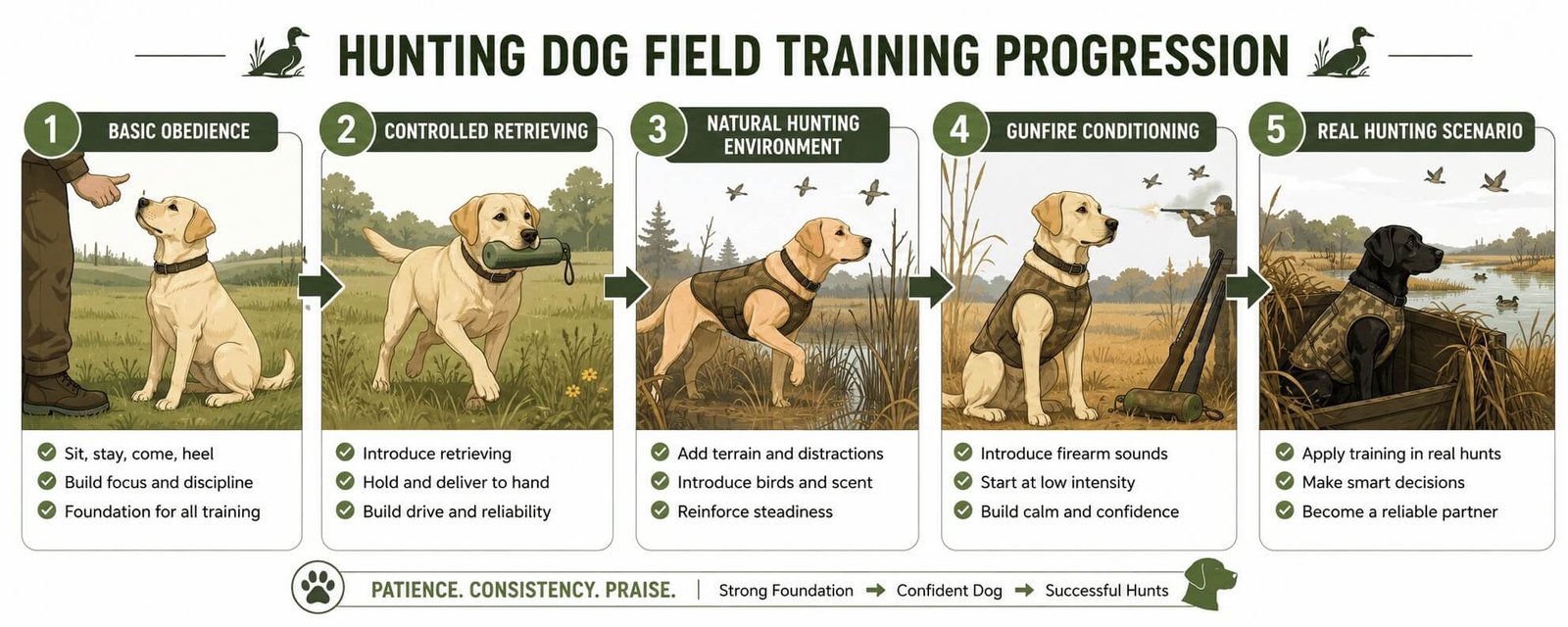
A hunting dog’s training should follow a gradual progression, moving from basic obedience to field skills as the dog develops confidence and control. Introducing advanced hunting scenarios before a dog understands fundamental commands often create confusion and unreliable responses.
Obedience training should progress gradually as your dog matures both physically and mentally. Introducing advanced skills too early can lead to frustration, while delaying basic obedience can create habits that are difficult to correct. The following timeline provides a practical framework for developing reliable hunting dog obedience before the first hunting season.
| Dog’s Age | Primary Training Focus |
|---|---|
| 8–12 Weeks | Build trust, socialize with people and environments, introduce name recognition, recall foundation, sit, and basic handling exercises using short, positive sessions. |
| 3–6 Months | Strengthen stay, heel, down, and recall. Begin leash manners, introduce retrieving games, and expose the puppy to different terrain and mild distractions. |
| 6–9 Months | Increase reliability around distractions, extend command duration, introduce whistle commands, hand signals, and structured retrieving drills. |
| 9–12 Months | Transition to realistic field scenarios, including hunting blinds, decoys, varied terrain, and controlled gunfire exposure. Reinforce steadiness and response under pressure. |
| 12 Months and Beyond | Continue advanced field obedience, blind retrieves, directional handling, and regular refresher sessions to maintain consistency throughout each hunting season. |
Every hunting dog develops at a different pace depending on breed characteristics, temperament, and training consistency. A Labrador Retriever preparing for waterfowl work progress differently from a pointing breed trained for upland birds. The goal is not to rush through commands but to build reliable responses that hold up when real hunting distractions are introduced.
Transitioning From Obedience Training to Field Work

A hunting dog that understands basic commands is ready for the next stage: learning how to apply those skills in realistic hunting environments. Field work is not about teaching new obedience commands; it is about helping the dog maintain the same level of control when faced with the sights, sounds, and excitement of an actual hunt.
The transition should be gradual. A dog that responds perfectly in a quiet training area may behave differently when exposed to birds, unfamiliar terrain, water, gunfire, or the movement of other hunters. Successful field preparation builds confidence by introducing these challenges one step at a time while maintaining the obedience foundation already established.
Introduce Natural Hunting Environments
Begin by practicing obedience in locations that resemble future hunting areas. Move training sessions from controlled spaces to fields, wooded areas, shorelines, or other environments where your dog will eventually work. As training becomes more realistic, properly fitting hunting dog vests can help protect your dog from brush, cold water, and rough terrain during field sessions.
During these sessions, continue reinforcing basic behaviors such as:
- waiting for release before moving
- responding to commands at a distance
- staying focused on the handler
- remaining calm around new smells and sounds
The goal is to teach the dog that obedience applies everywhere, not only in familiar training locations.
Add Hunting-Related Distractions Gradually
Hunting environments contain many distractions that can challenge even well-trained dogs. Birds, wildlife scents, decoys, water, equipment, and movement can trigger natural instincts.
Introduce these distractions progressively. Allow the dog to experience new situations while maintaining control rather than immediately expecting perfect performance in a full hunting scenario. For example, a retriever should first become comfortable around water before being expected to make difficult retrieves in cold conditions. A pointing dog should develop steadiness before working around active birds.
Prepare for Gunfire Carefully
Gunfire exposure should never be rushed. A dog that reacts negatively to loud sounds may develop fear that affects future hunting performance.
Introduce sound gradually in a controlled training environment and only after the dog shows confidence with basic field activities. Many trainers pair distant sounds with positive experiences, allowing the dog to build a calm association with gunfire.
Maintain Obedience During Excitement
The biggest difference between training and hunting is the level of excitement. A dog may perform commands correctly during practice but struggle when birds are moving, shots are fired, or other dogs are working nearby.
Continue reinforcing the same expectations:
- no breaking position without permission
- no uncontrolled chasing
- immediate response to recall
- calm behavior before and after retrieves
Progress at the Dog’s Own Pace
Every hunting dog develops differently depending on breed, temperament, previous training, and experience. Some dogs may quickly adapt to field conditions, while others need more gradual exposure.
Avoid advancing too quickly simply because a dog performs well during basic obedience. Strong field performance comes from building confidence, reliability, and communication over time.
FAQs About Make Hunting Dog Obedience
What age is a hunting dog ready for its first hunting season?
Most hunting dogs are introduced to their first hunting season after they have developed basic obedience, confidence in different environments, and reliable control around distractions. While some dogs may begin supervised field exposure earlier, full hunting responsibilities should depend on maturity, training progress, and the dog’s ability to respond consistently.
Do different hunting dog breeds need different obedience training?
Yes. Training methods should consider the breed’s natural abilities and hunting style. Retrievers often require strong retrieving control and water confidence, pointing breeds need steadiness and bird manners, while flushing dogs benefit from close-range handling and reliable recall. The obedience foundation remains similar, but field expectations vary by role.
Can an older hunting dog still learn obedience?
Yes. Older dogs can improve their obedience with structured training and consistent reinforcement. However, changing established habits may require more patience because older dogs may already have learned unwanted behaviors. Returning to basic commands and rebuilding reliability gradually is often the best approach.
Should hunting dogs wear an e-collar during obedience training?
An e-collar should not replace foundational obedience training. When introduced correctly, it can be used as a communication tool for advanced field control, especially during distance work and recall training. Dogs should first understand commands clearly before any electronic training tools are considered.
How do you maintain a hunting dog’s obedience during the off-season?
Maintaining obedience requires regular practice even when hunting season ends. Short refresher sessions, retrieving drills, outdoor walks, and occasional field-style training help prevent skill loss and keep commands reliable when hunting resumes.
What makes a hunting dog different from a regular pet dog?
A hunting dog is trained to work cooperatively with a handler in challenging environments while controlling natural instincts. Beyond basic manners, a trained gun dog must remain focused around wildlife, respond at distance, handle pressure, and perform specific tasks such as retrieving, pointing, or flushing game.
Conclusion
Reliable hunting dog obedience is built through patience, consistency, and structured training. A well-trained hunting dog is not created by advanced drills alone but by mastering the fundamentals that allow the dog to stay focused, respond quickly, and work confidently in challenging field conditions.
If you develop strong obedience, gradually introduce hunting environments, and reinforce commands throughout the year, you can build a dependable companion that performs with control and confidence.
Trusted Resources for Hunting Dog Training:
- American Veterinary Society of Animal Behavior – Humane Dog Training Guidelines
- American Kennel Club – Hunting Dog Training Resources
- Association of Professional Dog Trainers – Training Resources