Best Thermal Monoculars for the Money (2026)

Choosing a thermal monocular depends on more than detection distance or digital magnification. Sensor resolution, thermal sensitivity, lens size, refresh rate, battery life, handling, and actual street price all affect the experience.
In this guide, we compare thermal monoculars for different budgets and uses, including wildlife observation, hiking, and lawful hunting. We distinguish manufacturer-published specifications from our own observations, explain the trade-offs behind each recommendation, and highlight what to check before purchasing.
Quick Buying Advice: Start by deciding how much detail you need to see, how far away you expect to observe heat signatures, and how much you can spend. A higher advertised detection range does not necessarily mean you will be able to identify an animal clearly at that distance.
Prices, availability, and product specifications should be verified against current manufacturer or retailer listings before publication.
Best Thermal Monoculars in 2026
When assessing the top thermal monoculars, we take into account key factors including thermal sensor resolution, detection range, refresh rate, durability, battery life, ease of use, and cost. The featured models in our selection have advanced digital technology to penetrate darkness.
Comparison Table of the Top 5 Best Thermal Monoculars on the Market:
| Image | Product | Details | Link |
|---|---|---|---|
 | Our Top Pick Pulsar Axion 2 XQ35 | Resolution: 384 × 288 Frame Rate: 50 Hz Weight: 0.8 lb | Check on Amazon |
 | Editor’s Choice AGM Asp-Micro TM160 | Resolution: 160 × 120 Frame Rate: 50 Hz Weight: 0.6 lb | Check on Amazon |
 | Best Value FLIR Scout TK Handheld | Resolution: 160 × 120 Frame Rate: 9 Hz Weight: 6 oz | Check on Amazon |
 | Slim & Powerful ATN OTS LT 320 6-12X | Resolution: 320 × 240 Frame Rate: 60 Hz Weight: 1.2 lb | Check on ATN |
 | Easy to Use FLIR Scion OTM236 | Resolution: 320 × 256 Frame Rate: 60 Hz Weight: 572 g | Check on Amazon |
How We Evaluated These Thermal Monoculars
Choosing a thermal monocular requires more than comparing advertised detection distances or digital magnification. We evaluated the products in this guide using a consistent set of criteria designed to help readers understand their capabilities, limitations, and value for money.
Our Evaluation Criteria
- Thermal sensor resolution: We compare native sensor resolution because it affects the amount of thermal image information available for processing. Higher resolution can help reveal more detail, although lens quality, thermal sensitivity, image processing, and viewing conditions also matter.
- Detection range versus identification: We distinguish a manufacturer’s advertised detection range from the distance at which a person can recognize or identify an animal. Detection specifications are not directly interchangeable across brands and should not be treated as guaranteed field performance.
- Refresh rate and image processing: We consider the stated refresh rate and available image-processing features when assessing how suitable a device may be for observing moving wildlife.
- Lens and magnification: We examine the published lens specifications, field of view, and optical or digital magnification. Greater digital zoom does not increase the sensor’s native resolution and can make image limitations more noticeable.
- Portability and battery life: We compare published weight, dimensions, power arrangements, and manufacturer-stated battery life to help readers judge suitability for hiking, extended observation, and field use.
- Durability and support: We look for documented weather-resistance ratings, warranty terms, included accessories, and the availability of manufacturer support. These claims must be verified for the specific model and market.
- Price and overall value: We consider the available price evidence alongside specifications, practical features, and product availability. A cheaper device is not necessarily the better value if it has major limitations or cannot be purchased with reliable support.
Product Information and Source Verification
Product specifications should be checked against manufacturer product pages, manuals, and technical documentation wherever available. Retailer listings can help establish indicative prices and availability, but listings may contain outdated specifications, discontinued configurations, or incomplete information.
Before finalizing a recommendation, we check the exact model name, sensor resolution, refresh rate, lens configuration, advertised detection range, weight, battery information, warranty, and current purchase options. Where a specification cannot be confirmed from a reliable source, it should be marked as unverified rather than presented as an established fact.
Hands-On Testing and Research Limitations
Our recommendations should reflect the evidence actually available for each product. Manufacturer specifications and published retailer information can help establish technical capabilities, but they do not replace controlled, hands-on comparisons under real field conditions. We do not describe a product as personally tested unless we have directly handled and evaluated that exact model.
Where a recommendation is based on published specifications and product research, we identify it as research-based rather than implying first-hand testing. Advertised detection distances, battery-life figures, and image-quality claims vary with temperature differences, humidity, vegetation, target size, lens configuration, battery condition, and other environmental factors.
Our comparisons are intended to help readers narrow their choices, not to guarantee a particular result in the field. We also recognize that older products no longer be available new. For these models, buyers should verify seller reputation, device condition, warranty coverage, battery health where applicable, and access to support before purchasing.
Affiliate disclosure: This article may contain affiliate links. If you purchase through qualifying links, we may earn a commission at no additional cost to you. Affiliate relationships do not replace the need to verify product claims or explain a product’s limitations.
1. Pulsar Axion 2 XQ35 Thermal Monocular – Best Overall

If you’re considering an investment in a high-end thermal monocular, the Axion 2 XM35 could be an excellent choice. For those unfamiliar with the Pulsar brand, it’s worth noting that Pulsar is the manufacturer behind ATN, the official provider of thermal and night vision devices for the US Army.
The image quality is excellent, with faithful rendering with finesse, and thermal mapping superimposed on the video in real time. Its high price remains however the small lack to be underlined on this product, which is aimed at an essentially professional clientele. Its magnification of 2x to 8x, as well as its core of 384×288, makes this device a high-definition optical monocular.
Indeed, with this model, you are sure to have clear, sharp, and bright images. What further distinguishes this device from others is its lightweight (0.8 lbs). It is perfectly designed to be held in one hand or a standard pocket. Pulsar Axion 2 thermal monocular is completely waterproof, so you don’t have to worry even if you go hunting or hiking in rainy seasons while using it.
At the forefront of technology, this device has strong practical functions such as Wi-Fi connection, real-time video streaming, image and video capture, a frost-proof and damp-proof OLED screen, and a wide choice of palettes for visualizing thermal mapping.
PROS
- Military quality construction
- 100% Waterproof design
- Good performance & features
- High optical magnification
- Compact and light
CONS
- The main lens cover isn’t rubber coated
2. AGM Global Vision Asp-Micro TM160 – Editor’s Choice

The Asp-Micro TM-160 model, manufactured by the AGM Global Vision brand, is the one with the best value for the money. This is a portable observation thermal monocular that is equipped with a 160×120 infrared detector and a 720×540 Lcos screen. It has adaptive AGC, DDE and 3D DNR. This device also supports observation, high-temperature target tracking, and distance measurement functions.
The Asp-Micro short-range thermal monocular excels in its ability to measure distances by marking the top and bottom of the target, allowing for accurate height estimation. This functionality enhances the overall capability of the device. Do not underestimate the material that has satisfactory qualities and performance.
With its medium size and lightweight design, you can take it with one hand for long hours without getting tired. It delivers crisp and bright images no matter the weather or time of day. It also has a built-in memory module, which makes it possible to record images or videos instantly.
AGM Asp-Micro TM160 thermal monocular for hunting also detects and marks the hot spot of the highest temperature. However, the very limited number of options remains the small lack that we observed on this product during our test. You can also check out the more advanced AGM Taipan TM25-384.
PROS
- Military-grade thermal imaging
- Very functional and easy to use
- Reasonable price
- Robust construction
CONS
- Works well in declared functions but not for long distances
3. FLIR Scout TK Handheld Thermal Monocular – Best Value

Are you looking for a powerful and stable thermal monocular for a hunting trip? Then the Scout TK meets all these criteria perfectly. This magnificent monocular developed by the famous brand FLIR promises you a clear and precise image.
The qualities that we appreciate most about this monocular concern the neutrality of the colors and its thermal camera. Darkness or weather conditions do not affect this monocular. You can instantly capture images or videos of animals up to 300 feet away. Its field of vision is 18° x 14° and its nominal range is 1140m! Yes!
This model is fully rechargeable with an average battery life of 5 hours. The onboard display of this thermal monocular delivers exceptional quality, deserving recognition among the best professional thermal devices. Long-term observation does not tire the eyes because its refresh rate is 60hz.
And to facilitate observation in all conditions, you have the choice of 3 thermal display modes: White hot, Black hot and Install. This last name actually hides the most used visualization mode in the world of thermal imaging.
The Scout TK also has many other functions, such as video sequence recording, real-time image capture, Wifi & Bluetooth connection for wireless image transmission, Geotag insertion in the data EXIF images, as well as an autonomous period of about 5 hours. If your budget allows it, go for it!
PROS
- Compact and lightweight
- Elegant and beautiful design
- High quality manufacturing materials
- Good battery power
- Very easy to use
CONS
- Fixed battery
- No Magnification
4. ATN OTS LT 320 6-12X Powerful Thermal Monocular

The ATN OTS-XLT 320 thermal monocular is a first-class instrument that helps you detect thermal signatures. It’s compact, ergonomic and lightweight, so you can take it anywhere. It also has a long-lasting battery of over 10 hours, so you can use it for long periods of time without worrying about recharging.
White Hot/Black Hot or Color modes display moving objects in any color palette you choose. A 60Hz refresh rate sensor provides range performance to help detect heat signatures.
The ATN OTS-XLT 320 Thermal Monocular stands out as the best long-range thermal monocular for hunting. Unlike traditional night vision devices, it doesn’t rely on infrared illuminators or favorable atmospheric conditions to produce a clear image. This makes it highly versatile, offering reliable performance in both daytime and nighttime environments.
It has 19mm eye relief and comes with 6-12× digital zoom. The detector type of this monocular is an uncooled vanadium oxide focal plane array. The OTS-XLT 320 model is the obvious choice for those who don’t want to compromise the quality of their thermal night vision.
PROS
- Powerful and weather resistant
- Good detection range
- Compact and Ergonomic
- Simple to control and operate
- Comes with 3 years warranty
CONS
- Wide viewing angle isn’t great
5. FLIR Scion OTM236 Thermal Imaging Monocular

The exceptional characteristics of the FLIR Scion OTM236 thermal monocular prove that the brand of optical equipment has lost none of its reputation and reliability. Thanks to its robust and durable material design, this thermal monocular is built to withstand various environmental challenges and ensure resilience.
It shows excellent performance in all circumstances. With this device, you are sure to have a good and resistant ally for a long time. FLIR Scion OTM236 thermal monocular is particularly effective for night hunts.
Its thermal camera, with the intuitive Ergo Control operating concept, allows you to identify your target with precision. The quality of visual effects and images lies in its ability to maintain images in a vivid and sharp manner. Its high-definition screen faithfully reproduces the natural colors of your landscape (objects, animals, etc.).
The FLIR Scion OTM236 starts up in seconds and requires no training to use. You can see in the dark and detect heat signatures of people or animals in complete darkness or bright light. It offers a smooth 30-60Hz frame rate for crisp thermal images and comes in rugged weatherproof housing.
The 640×480 LCD screen enhances the viewing experience, making it effortless to discern and analyze details in your observation. It weighs just 572 grams but can withstand hard drops and shallow water. However, the small lack that we can highlight on this product concerns its price a little high. But that’s what the high-end costs.
PROS
- Easy to carry
- Smart and redesigned user interface
- Excellent thermal detection
- Sturdy carry case
CONS
- Small resolution
- No attachment for a lanyard
Quick Verdict: Best Thermal Monoculars for the Money
| Thermal Monocular | Best For | Key Specifications | Price Guide | Amazon |
|---|---|---|---|---|
| Pulsar Axion 2 XQ35 | Best Overall (conditional) | 384 × 288 thermal sensor; 50 Hz refresh rate | Check current price and availability | Check on Amazon |
| AGM Asp-Micro TM160 | Best Budget | 160 × 120 thermal sensor; 50 Hz refresh rate | Check current price and stock | Check on Amazon |
| FLIR Scout TK Scope | Compact, lightweight use | 160 × 120 thermal sensor; 9 Hz refresh rate | Verify availability; this model may be discontinued | Check on Amazon |
| ATN OTS LT 320 6–12x | Higher-magnification scanning | 320 × 240 thermal sensor; verify the exact configuration | Confirm current price and model availability | Check on Amazon |
| FLIR Scion OTM236 | Alternative to investigate | 320 × 256 thermal sensor | Verify current price and availability | Check on Amazon |
If you’re comparing handheld thermal viewers with optics designed for mounted use, our best thermal scopes reviews and buyer’s guide can help you understand the differences before choosing the right equipment.
The Pulsar Axion 2 XQ35 is worth considering if you can find the exact model at a competitive price. The AGM Asp-Micro TM160 is an option for budget-conscious buyers, and shoppers comparing high-magnification devices should remember that digital zoom does not increase the thermal sensor’s native resolution.
How to Choose the Best Thermal Monoculars?
The optimal thermal monocular is the model that aligns with your specific needs and expectations. To identify the most suitable device, it’s crucial to consider certain essential details.
Price
The budget allocated to the purchase of a thermal monocular is a crucial criterion, as prices vary based on brands and the features offered in different models. Whether in an online store or a physical store, it is possible to find a thermal monocular for less than 100 dollars.
However, with this type of device, the quality may be lacking. To buy a top-of-the-range thermal monocular, you need to plan no less than 1000 dollars.
Magnification
After the price, the magnification is an element not to be taken lightly. The reason is quite simple: if you buy a thermal monocular with inadequate magnification, you risk having blurry and imprecise images. A monocular with high magnification (between 6 and 10) is generally recommended for hunting or hiking.
Magnification works similarly across optics—just like choosing a crossbow optic where clarity and zoom balance is critical (see our guide on the best crossbow scopes for hunting accuracy.
Lens diameter

For hunting or hiking, we recommend a lens between 30 to 50 mm in diameter. This type of device will allow you to see sharper details at dusk or night, even in the most extreme weather conditions. It also improves visual comfort while providing bright images.
A similar principle applies in long-range optics such as spotting scopes, where larger lenses are essential for extreme distance viewing (like in our review of the best spotting scopes for 1000 yards. When estimating distances is important during outdoor observation, a dedicated rangefinder can serve a different purpose from thermal imaging.
Processing software
When choosing a thermal monocular, it is important to give preference to the model that has high-end processing software. This will significantly increase your target accuracy while displaying small details in the field of view.
High-end optical processing is also crucial in precision shooting optics like target spotting scopes used for range training (see our breakdown of the best spotting scopes for target shooting.
Power of thermal vision
This is one of the most important details to consider when buying this type of device. Indeed, a monocular with high thermal vision power offers a clear view, even in total darkness. If your main goal is observing animals and identifying visible details rather than detecting heat signatures, conventional optics also suit your needs.
Accessories: tripod and carrying bag
Some accessories are as important as a good thermal monocular. Indeed, the tripod for example is an accessory that can ensure your comfort when you view with your thermal monocular. On the market, some monocular models come with a tripod. Also, choose the model that contains a cover for storage. Additionally, a model that comes with an optical cleaning wipe might also be worth your attention.
For users who also observe distant targets with a spotting scope, choosing a stable support matters; our spotting scope tripods reviews cover options for that type of setup.
Ease to carry
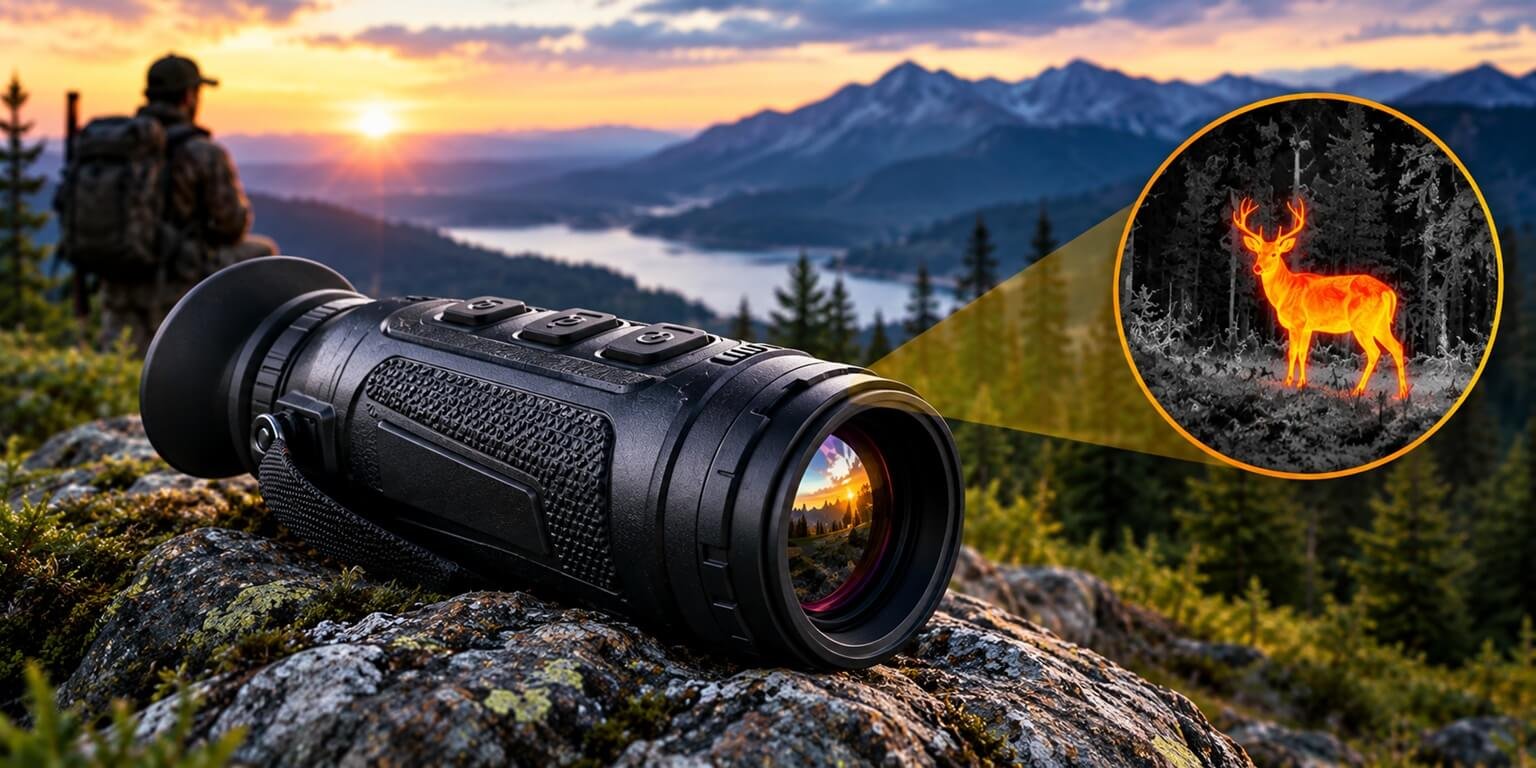
Portability and user comfort are also key features to prioritize when selecting a thermal vision monocular. In a photo of a person holding a thermal monocular for your reference, a hunting thermal camera should be easy to carry and provide ergonomics that prevent fatigue during prolonged use.
For hunters who also want to monitor wildlife activity over longer periods without constantly visiting the same location, check out the best solar trail cameras covers another useful option for remote observation.
FAQs About Thermal Monoculars 2026
Can a thermal monocular see through trees or glass?
A thermal monocular cannot see through solid objects such as tree trunks, walls, or ordinary glass. Foliage may partially obscure an animal, and branches can block its heat signature. Standard glass generally blocks much of the long-wave infrared radiation used by thermal imaging devices, so a monocular generally cannot detect a target through a closed window. Always consider obstructions when scanning an area.
Can rain, fog, or cold weather affect thermal monocular performance?
Yes. Heavy rain, dense fog, high humidity, and other atmospheric conditions can reduce the distance at which a thermal monocular provides a useful image. Performance also depends on the temperature contrast between the target and its surroundings.
Cold weather can affect battery runtime, so check the manufacturer’s operating-temperature range and battery recommendations before using a device outdoors.
What is the difference between a thermal monocular and a thermal scope?
A thermal monocular is a handheld observation device designed to scan an area and view heat signatures. A thermal scope is designed to mount on a compatible firearm or other supported platform for aiming. They serve different purposes and should not be treated as interchangeable. Before purchasing either device for hunting, verify its intended use, mounting requirements, and applicable local laws.
Can animals be detected with a thermal monocular when they are hiding in thick cover?
A thermal monocular helps reveal an animal’s heat signature when some of its body is visible, but it cannot reliably detect an animal through dense vegetation, solid barriers, or other materials that block infrared radiation. Leaves, branches, distance, weather, and the temperature difference between the animal and its surroundings all affect visibility. A detected heat signature should not automatically be treated as a confirmed species identification.
How long does a thermal monocular battery last?
Battery life varies by model, battery capacity, display brightness, wireless connectivity, recording activity, and ambient temperature. Check the manufacturer’s stated runtime for the exact model rather than assuming all devices in the same product family perform alike.
For extended outdoor trips, consider whether the battery is replaceable, whether charging is possible in the field, and how much spare power you may need.
Should you choose thermal imaging or night vision for nighttime hunting?
Thermal imaging detects differences in heat radiation, on the other hand, conventional night vision uses available light or infrared illumination to produce a visible image. Thermal devices can be useful for spotting heat signatures in darkness, whereas night vision may provide more recognizable visual details under suitable conditions.
The better option depends on your intended use, terrain, budget, and local hunting rules. For a comparison with conventional nighttime optics, see our guide to the best night vision scopes for coyote hunting.
Conclusion
Choosing the right thermal monocular depends on your budget, intended use, image quality requirements, and the distances at which you need to detect heat signatures. Compare each model’s verified specifications, battery life, portability, and warranty before making your decision. Remember that advertised detection range does not guarantee clear identification at that distance.
If you’re still deciding which model suits your needs, compare the options in our guide and check current availability before purchasing. You can also leave a comment with your intended use or questions, and we’ll do our best to help.