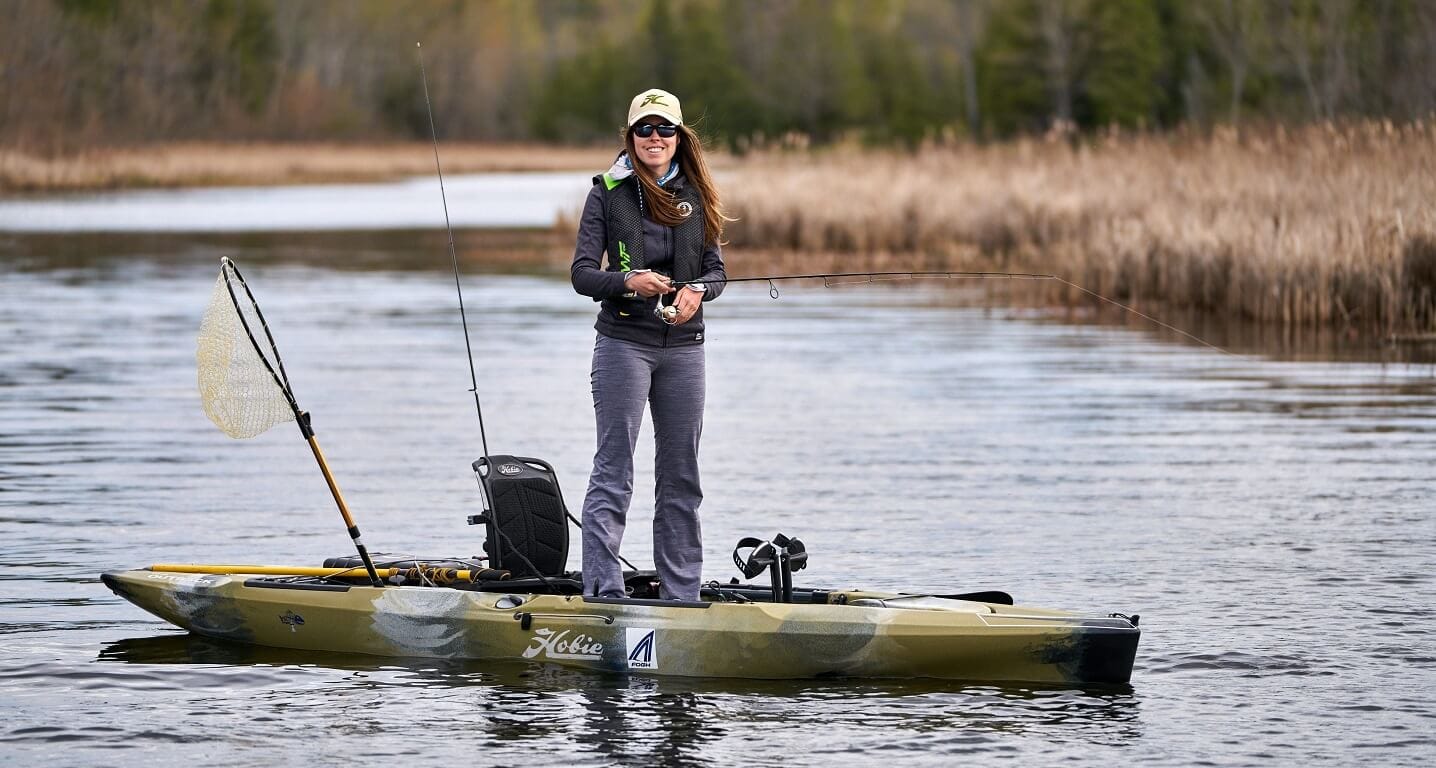
Best Pedal Fishing Kayaks for 2026: Top 5 Picks

Finding the best pedal fishing kayaks can heighten your fishing adventures, offering hands-free convenience and enhanced mobility on the water. These kayaks combine efficiency with comfort, letting you focus on catching your next big trophy instead of paddling.
Whether you’re an angler looking for precision or just want to enjoy fishing with minimal effort, a pedal fishing kayak is an excellent investment. If you’re still comparing different kayak styles and features, our guide to the best fishing kayaks for 2026 covers additional options for different fishing needs. Below, we’ve reviewed the top five options on the market, complete with detailed descriptions, specs, pros, and cons.
Top 5 Pedal Fishing Kayaks for Performance
The top 5 pedal fishing kayaks are designed for unmatched performance and fishing convenience.
| Kayak Model | Length | Weight | Capacity | Drive System | Star Rating |
|---|---|---|---|---|---|
| Hobie Mirage Outback | 12’9” | 85 lbs | 425 lbs | MirageDrive 180 | ★★★★★ |
| Old Town Sportsman PDL 120 | 12’ | 96 lbs | 500 lbs | PDL Drive | ★★★★☆ |
| Perception Pescador Pilot 12 | 12’5” | 85 lbs | 475 lbs | Pilot Drive | ★★★★☆ |
| Wilderness Systems Radar 135 | 13’6” | 90 lbs | 475 lbs | Helix PD Pedal Drive | ★★★★☆ |
| Native Watercraft Slayer Propel 10 | 10’ | 62 lbs | 400 lbs | Propel Pedal Drive | ★★★★☆ |
How We Evaluated: We compared these pedal fishing kayaks based on their published specifications, drive-system design, stability, fishing-focused features, portability, and overall value. Where hands-on experience was available, we also considered real-world use and comfort.
1. Hobie Mirage Outback – Best All-Around Fishing Kayak

Tech Specs:
- Length: 12’9”
- Width: 34”
- Weight: 85 lbs (fully rigged)
- Capacity: 425 lbs
- Drive System: MirageDrive 180 with Kick-Up Fins
- Star Rating: ★★★★★
- Check Price On Amazon
The Hobie Mirage Outback is a top-tier pedal fishing kayak well-known for its versatility, stability, and innovative features. Designed for anglers of all levels, it combines advanced MirageDrive technology with a spacious layout, making it perfect for extended fishing trips.
The MirageDrive 180 system provides smooth pedaling and reverse capabilities. Its wide, stable hull ensures you can confidently stand while casting. Furthermore, multiple rod holders and gear compartments keep everything within reach. The Vantage CTW seat offers exceptional convenience without fatigue.
Pros:
- Stable for standing and casting
- High-capacity storage for gear
- Adjustable seating mechanism
- Kick-up fins for navigating shallow waters
Cons:
- Premium price
- Heavy to transport without assistance
2. Old Town Sportsman PDL 120 – Best Kayak for Beginners
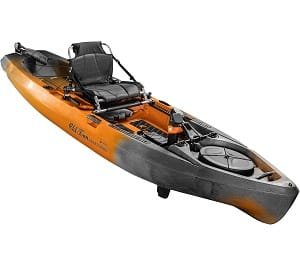
Tech Specs:
- Length: 12’
- Width: 36”
- Weight: 96 lbs
- Capacity: 500 lbs
- Drive System: PDL Drive
- Star Rating: ★★★★☆
- Check Price On Amazon
For those new to pedal kayaks, the Old Town Sportsman PDL 120 provides a user-friendly experience without making concessions about quality. Its instant forward and reverse PDL Drive system is intuitive and requires minimal maintenance.
The kayak’s stable hull design inspires confidence, even in choppy waters. Its adjustable seat ensures comfort for long days on the water. With built-in rod holders, accessory tracks, and a large stern storage area, it’s constructed for hassle-free fishing.
Pros:
- Easy to use and maintain
- High weight capacity
- Comfortable seating and ample storage
- Durable, reliable drive system
Cons:
- Heavier than some competitors
- Slower speed compared to high-end models
3. Perception Pescador Pilot 12 – Affordable Pedal Fishing Kayak
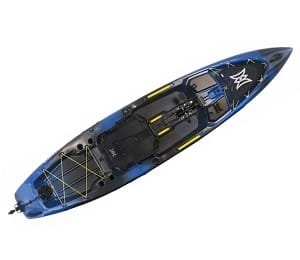
Tech Specs:
- Length: 12’5”
- Width: 33.75”
- Weight: 85 lbs
- Capacity: 475 lbs
- Drive System: Pilot Drive Propeller System
- Star Rating: ★★★★☆
- Check Price On Amazon
I’ve owned the Perception Pescador Pilot 12 for about four months and have taken it on approximately eight fishing trips. During that time, I particularly appreciated its stability and comfortable seating during longer sessions. The Perception Pescador Pilot 12 delivers exceptional value for anglers seeking a pedal fishing kayak on a budget. Despite its lower price, it doesn’t skimp on features or quality.
This kayak boasts a Pilot Drive propeller system for effortless pedaling and a spacious deck with plenty of room for gear and accessories. Its premium seat ensures comfort, while its wide hull offers stability for standing casts.
Pros:
- Budget-friendly price
- Stable platform for standing
- Adjustable and comfortable seat
- Plentiful storage space
Cons:
- Slightly noisier drive system
- Limited reverse capability
4. Wilderness Systems Radar 135 – Best Pedal Kayak for Versatility
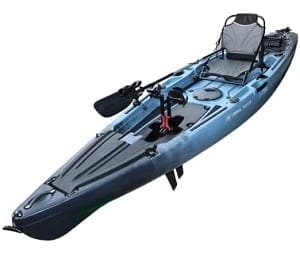
Tech Specs:
- Length: 13’6”
- Width: 34”
- Weight: 90 lbs
- Capacity: 475 lbs
- Drive System: Helix PD Pedal Drive (optional motor)
- Star Rating: ★★★★☆
- Check Price On Amazon
Wilderness Systems, crafting exceptional kayaks since 1986, blends innovative designs with premium quality and performance. The Wilderness Systems Radar 135 ranked position with its tri-powered capabilities—pedal, paddle, or motorize it. This makes it one of the most versatile options for anglers seeking flexibility.
The AirPro MAX seat provides excellent comfort and adjustability. The SMART hull technology delivers superior tracking and stability. With expansive storage options and accessory tracks, it’s ideal for multi-day fishing trips.
Pros:
- Tri-powered for ultimate versatility
- Relaxing seat for extended trips
- Excellent stability and tracking
- Big space for gear and accessories
Cons:
- Pedal drive sold separately
- Heavier than similar models
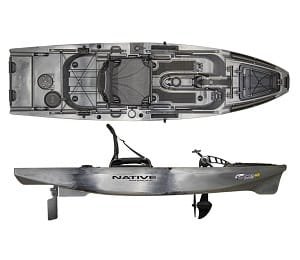
5. Native Watercraft Slayer Propel 10 – Compact Pedal Fishing Kayak
Tech Specs
- Length: 10’
- Width: 34”
- Weight: 62 lbs
- Capacity: 400 lbs
- Drive System: Propel Pedal Drive
- Star Rating: ★★★★☆
- Check Price On Amazon
If portability is your priority, the Native Watercraft Slayer Propel 10 is a compact pedal fishing kayak. It’s ideal for small bodies of water and anglers looking for a lightweight, agile kayak. Also, If you are tired of sore neck and shoulders, this will change the experience of kayaking.
The Propel Pedal Drive system offers precise control and the ultra-stable hull ensures smooth fishing, even when standing. With multiple storage compartments and accessory mounts, it’s perfect for day trips or tight spaces. If you are looking to improve handling on a river, there are rudder upgrades available.
Pros:
- Compact and lightweight design
- Easy to transport and store
- Stable enough for standing
- Smooth and efficient pedal drive
Cons:
- Limited storage space
- Not ideal for rough waters
Product specifications: Manufacturer specifications were checked against current product information where available. Specifications can vary by model year or configuration, so verify final dimensions, weight, capacity, and included equipment before purchasing.
Pedal vs. Paddle Fishing Kayaks: Which Is Better?
| Factor | Pedal Kayak | Paddle Kayak |
| Hands-free fishing | Excellent | Limited |
| Long-distance travel | Easier for many anglers | More effort |
| Shallow/rocky water | Drive-dependent | Usually simpler |
| Weight | Usually heavier | Usually lighter |
| Maintenance | More components | Simpler |
| Price | Usually higher | Often lower |
How to Choose the Best Pedal Fishing Kayak
Choosing a pedal fishing kayak involves more than comparing length, weight, and price. The right model should match the type of water you fish, how much equipment you carry, how far you travel, and how easily you can transport and store the kayak.
Choose the Right Pedal Drive for Your Fishing Style
Pedal kayaks generally use either a propeller-style or fin-style drive. Propeller systems are well suited to anglers who want efficient forward movement and responsive control, while fin drives can be particularly useful when maneuvering around vegetation or operating in areas where the drive can be raised or protected.
Pay attention to how the drive is deployed, removed, and protected rather than choosing solely by the brand name. A drive that is easy to lift or remove can make launching, landing, and transporting the kayak considerably easier.
Match the Kayak to Your Fishing Environment
Think about where you will use the kayak most often before choosing a model. A compact kayak can be convenient for small ponds, narrow rivers, and short fishing trips, while a longer hull can provide better tracking when covering larger lakes or reservoirs.
- Small lakes and ponds: Prioritize maneuverability, easy transport, and a compact footprint.
- Large lakes and reservoirs: Look for efficient tracking, adequate storage, and enough capacity for longer trips.
- Slow-moving rivers: A maneuverable hull and responsive steering can be more useful than maximum length.
- Coastal fishing: Prioritize appropriate hull stability, capacity, drainage, and a design suited to local water and weather conditions.
No pedal fishing kayak should be treated as automatically suitable for every condition. Check the manufacturer’s guidance and your local conditions before using a kayak on open or rough water.
Check the Usable Weight Capacity, Not Just the Published Capacity
Weight capacity includes more than the angler. Your fishing tackle, rods, battery or electronics, cooler box, safety equipment, water, and other accessories all contribute to the total load.
For example, an angler who weighs 200 pounds and carries 40 pounds of equipment is already placing a 240-pound load in the kayak. Leaving additional capacity gives you more flexibility for changing conditions and gear rather than operating close to the manufacturer’s maximum rating.
Consider Length and Width Together
Kayak dimensions affect how the boat behaves on the water and how difficult it is to transport. Longer kayaks generally favor straight-line tracking, on the other hand, shorter models can be easier to maneuver and store. Width also affects the balance between stability and handling.
Do not automatically assume that the widest kayak is the best choice. Consider whether you need a large standing platform, how much space you have for transportation, and whether you regularly fish narrow waterways.
Think About Transport Before You Buy
Pedal fishing kayaks can be considerably heavier than basic recreational kayaks because of their reinforced hulls, seating systems, drives, and fishing accessories. A kayak that performs well on the water can still become frustrating if you cannot comfortably move it from your vehicle to the launch.
Check the kayak’s actual ready-to-fish weight and consider how you will load it. If you normally fish alone, features such as carrying handles, wheels or a compatible kayak cart, and a removable pedal drive can make a noticeable difference.
Evaluate the Fishing Layout for Your Actual Gear
Instead of counting rod holders and storage compartments, think about where your equipment will sit while you are actively fishing. Your tackle box, fish finder, phone, pliers, landing net, drinks, and other frequently used items should be accessible without forcing you to turn excessively or reach across the deck.
Also check the kayak’s accessory mounting options if you plan to add electronics, additional rod holders, cameras, or other fishing equipment later. A flexible rigging system can be more valuable than a long list of built-in accessories you may never use.
Look at Seat Adjustability for Full-Day Trips
Pedal kayaks are often chosen for longer fishing sessions, so seating deserves more attention than it receives in many product comparisons. Look for a seat that allows you to adjust your position and provides adequate support while pedaling.
Your leg position should also allow a comfortable pedal stroke without forcing your knees into an awkward position. If possible, try the seating and pedal setup before purchasing, especially if you regularly spend several hours on the water.
Consider Your Launch and Landing Routine
The pedal drive can improve movement once you are on the water, but it can also affect how you approach shallow launches, rocky shorelines, beaches, and boat ramps. A removable or retractable drive can simplify the transition between land and deeper water.
Think through your normal launch point before buying. A kayak that works perfectly from a clean boat ramp may be less convenient if you regularly launch from a muddy bank, shallow shoreline, or uneven access point.
Budget for More Than the Kayak
The purchase price is only part of the cost of owning a pedal fishing kayak. Depending on the model and your fishing setup, you also need a paddle, personal flotation device, kayak cart, transportation system, fish finder, battery, tackle storage, anchor system, and other accessories.
Set a complete fishing budget rather than using the kayak’s sticker price as your only limit. A less expensive kayak that already includes the features you need can sometimes provide better overall value than a premium hull that requires numerous additional purchases.
Check Replacement Parts and Drive-Service Support
A pedal drive contains moving components that may eventually require inspection, replacement, or servicing. Before purchasing, check whether replacement parts and service information are readily available for the drive system.
This matters particularly for anglers who fish frequently or use their kayak in saltwater. Easy access to manufacturer support and replacement components can reduce downtime if a drive component eventually needs attention.
Decide Whether Portability or On-Water Performance Matters More
There is usually a trade-off between having a large, feature-rich fishing platform and having a kayak that is easy to move and store. A larger kayak gives you more deck space and carrying capacity, while a smaller model can be easier to load, transport, and launch.
If you fish frequently from different locations, portability deserves a higher priority. If you primarily launch from one convenient location and spend full days on the water, additional deck space, storage, and tracking performance may be more valuable.
Conclusion
Choosing the best pedal fishing kayak depends on your priorities. Its portability, stability, or budget-friendliness play a significant role. The Hobie Mirage Outback leads the pack with its advanced features and all-around performance. For beginners, the Old Town Sportsman PDL 120 is a reliable choice, while the Perception Pescador Pilot 12 offers excellent value. Whatever your needs, there’s a pedal fishing kayak in this list ready to enhance your time on the water.
Frequently Asked Questions (FAQs)
What makes a pedal fishing kayak better than a paddle kayak?
Pedal fishing kayaks provide hands-free operation, allowing you to focus on fishing rather than paddling. This is especially helpful for anglers who need to navigate while casting or reeling. Pedal systems also tend to be faster and more efficient, offering better control in windy or current-heavy conditions.
Can pedal fishing kayaks handle shallow waters?
Yes, most pedal fishing kayaks are designed to handle shallow waters, but it depends on the pedal drive system. Some models feature a retractable or kick-up fin system that minimizes damage in low-depth areas. However, be cautious in extremely shallow or rocky environments to avoid damaging the drive system.
Are pedal kayaks suitable for beginners?
Absolutely! Many pedal kayaks are beginner-friendly, thanks to their stability and ease of use. Models with wide hull designs and intuitive pedal systems are perfect for new anglers looking to improve their kayaking and fishing skills simultaneously.
How do I maintain the pedal drive system?
Maintaining a pedal drive system is straightforward. Rinse it thoroughly with fresh water after each use, especially after saltwater trips, to prevent corrosion. Regularly inspect moving parts for wear and lubricate them as needed. Always follow the manufacturer’s recommendations for long-term care.
Can I use a pedal fishing kayak in rough waters?
Many pedal fishing kayaks are built for diverse conditions, including rougher waters. Models with robust hull designs and efficient pedal systems perform well in choppy lakes or coastal waters. However, always check the kayak’s specifications to ensure it’s suited for your intended environment.